Finding out your newborn has clubfoot can feel overwhelming. In that moment, questions flood your mind: Will my baby walk normally? Is surgery necessary? Where do I find the right specialist in Bangalore? The good news is that clubfoot is one of the most treatable congenital conditions in pediatric orthopedics, especially when addressed early.
As the best paediatric orthopaedic doctor in Bangalore, Dr. Vijaykumar D has helped hundreds of families navigate this journey from diagnosis to a full, active life. This guide answers every question parents are asking, from what clubfoot actually is to what modern treatment looks like and what long-term outcomes to expect.
What Is Clubfoot in Newborns?
Clubfoot (talipes equinovarus) is a congenital foot deformity where one or both feet are twisted inward and downward at birth. The foot appears to point inward, with the sole facing sideways or upward. It affects the muscles, tendons, and bones of the foot and ankle, making normal positioning impossible without treatment. There are two main types: idiopathic clubfoot (the most common, with no known cause) and syndromic clubfoot (associated with other conditions such as spina bifida or arthrogryposis). The idiopathic type responds exceptionally well to non-surgical treatment.How Common Is Clubfoot?
Clubfoot affects approximately 1 in every 1,000 live births globally, making it one of the most common congenital musculoskeletal conditions. In India, the incidence is consistent with global statistics. It occurs in both feet in about 50% of cases and is more common in boys than girls (approximately 2:1 ratio). Parents in Bangalore can take comfort in knowing this is a well-understood condition with high treatment success rates.Causes of Clubfoot in Babies
The exact cause of idiopathic clubfoot is not fully understood. Current research points to a combination of genetic and environmental factors. Possible contributing factors include:- Abnormal muscle and tendon development in the womb
- Genetic predisposition (a family history of clubfoot increases risk)
- Reduced amniotic fluid (oligohydramnios) restricting fetal movement
- Positional factors in the uterus during development
Risk Factors During Pregnancy
While clubfoot can occur without any identifiable risk factor, certain conditions increase the likelihood:- Family history of clubfoot
- Male sex of the baby
- Twin pregnancies (limited uterine space)
- Smoking during pregnancy
- Oligohydramnios (low amniotic fluid)
- Associated neuromuscular conditions such as spina bifida
Signs and Symptoms of Clubfoot
Clubfoot is typically visible at birth and does not cause pain in newborns. Key signs include:- Foot turned inward and downward
- The top of the foot faces sideways or toward the ground
- Tight Achilles tendon pulling the heel upward
- Shortened and thickened tendons on the inside of the foot
- Smaller calf muscles on the affected side
- If bilateral (both feet), legs may appear bowed
When Should Parents Be Concerned?
Any newborn diagnosed with clubfoot should be seen by a pediatric orthopedic specialist within the first week or two of life. The earlier treatment begins, the better the outcome. Do not wait to see if it resolves on its own, as clubfoot does not correct spontaneously without intervention.How Clubfoot Is Diagnosed
Diagnosis is primarily clinical, based on a physical examination of the newborn. A specialist assesses:- The position, stiffness, and flexibility of the foot
- Severity using the Pirani scoring system (a scale of 0-6, where higher scores indicate greater severity)
- Presence of associated conditions
Why Early Treatment Matters
Early treatment of clubfoot is critical because:- Newborn tissues are highly flexible and responsive to gentle manipulation
- The bones, tendons, and ligaments are more malleable in the first weeks of life
- Early correction reduces the need for surgery
- Treatment started in the first two weeks yields the best long-term outcomes
- Delay increases stiffness, making correction harder and more invasive
What Is the Ponseti Method?
The Ponseti method is the internationally accepted, gold-standard, non-surgical treatment for idiopathic clubfoot. Developed by Dr. Ignacio Ponseti at the University of Iowa, it involves a series of gentle manipulations and plaster casts applied weekly to gradually correct the foot deformity. It is safe, effective, and highly successful when started early. The Ponseti method is now the first-line treatment recommended by the American Academy of Orthopaedic Surgeons (AAOS), the World Health Organization (WHO), and leading pediatric orthopedic bodies worldwide. Dr. Vijaykumar D is an experienced Ponseti method specialist in Bangalore.Step-by-Step Clubfoot Treatment Process
1. Serial Casting
Treatment begins within the first week or two of life. The specialist gently manipulates the foot into a more correct position, then applies a plaster cast from the toes to above the knee to hold the foot in place. This process is repeated weekly, with each cast gradually correcting the deformity over 5-8 weeks. Most families notice visible improvement with each cast change.2. Achilles Tenotomy
In approximately 85-90% of cases, a small procedure called an Achilles tenotomy is performed as the final step of casting. Under local anesthesia, the tight Achilles tendon is gently cut to allow the heel to drop into a normal position. A final cast is then applied for 3 weeks while the tendon heals. This is a minor outpatient procedure, not major surgery.3. Bracing Phase
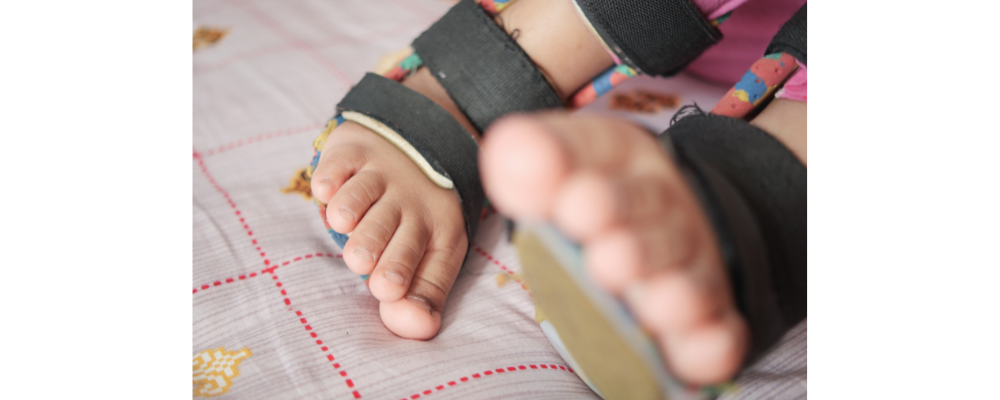
After casting is complete, the corrected foot must be maintained using a foot abduction brace (FAB), also called the Denis Browne bar or boots-and-bar brace. The brace is worn 23 hours a day for 3 months, then gradually reduced to nighttime and nap times until the child is 4-5 years old. Consistent brace use is critical to prevent clubfoot recurrence.Can Clubfoot Be Corrected Without Surgery?
Yes. In over 95% of idiopathic clubfoot cases treated with the Ponseti method, full correction is achieved without major surgery. Only minor procedures such as Achilles tenotomy (tendon release) are needed, which is done under local anesthesia and is not classified as surgery in the traditional sense. True surgical correction is reserved for very complex, resistant, or neglected cases.When Is Surgery Needed?
Major surgical correction of clubfoot may be required when:- The clubfoot is severe and not responding to conservative treatment
- Treatment was significantly delayed and the foot has stiffened
- There is a clubfoot relapse that does not respond to re-casting
- The clubfoot is syndromic (associated with spina bifida or other conditions)
- Older children (above 2 years) with neglected, uncorrected clubfoot
Clubfoot Treatment Timeline
| Phase | Timeframe | What Happens | Key Goal |
| Initial Assessment | Week 1-2 of life | Diagnosis, Pirani scoring, baseline assessment | Confirm diagnosis & plan treatment |
| Serial Casting | Weeks 2-8 (5-8 casts) | Weekly casts to gradually correct foot position | Achieve optimal foot alignment |
| Achilles Tenotomy | After final cast | Minor outpatient tendon release under local anesthesia | Allow heel to drop to normal position |
| Final Cast | 3 weeks post-tenotomy | Last corrective cast while tendon heals | Maintain corrected position |
| Full-Time Bracing | First 3 months after casting | Brace worn 23 hours/day | Prevent relapse |
| Part-Time Bracing | Up to age 4-5 years | Brace worn during sleep/naps | Long-term maintenance |
| Follow-Up | Every 6-12 months | Orthopedic monitoring | Detect and prevent recurrence |
Recovery and Long-Term Outcomes
Children who receive early, properly managed clubfoot treatment in Bangalore can expect:- Normal or near-normal foot function and appearance
- Ability to walk, run, jump, and participate in all physical activities
- No significant pain in daily life
- Normal shoe fitting in most cases
- Participation in sports and active lifestyle
Success Rates of Clubfoot Treatment
The Ponseti method has a documented success rate of 90-95% for achieving full correction in idiopathic clubfoot. Long-term follow-up studies show that children treated with the Ponseti method have excellent functional outcomes, with normal gait in the vast majority of cases when treated early and bracing compliance is maintained.Risks of Delaying Treatment
Delaying clubfoot treatment significantly worsens outcomes:- The foot becomes increasingly rigid and harder to correct
- The likelihood of requiring major surgery increases substantially
- Soft tissue and bone deformities become more severe
- The child may develop compensatory gait abnormalities
- Treatment duration becomes longer and more intensive
- Walking ability and foot function may be permanently compromised
Common Myths About Clubfoot
Understanding the truth about clubfoot helps parents make informed decisions:- Myth: Clubfoot will fix itself as the baby grows. Fact: Clubfoot never corrects on its own. Early specialist treatment is essential.
- Myth: Clubfoot always requires surgery. Fact: Over 95% of cases are successfully treated without major surgery using the Ponseti method.
- Myth: Babies feel pain during casting. Fact: Gentle manipulation and casting are well-tolerated by newborns.
- Myth: Children with treated clubfoot cannot participate in sports. Fact: With successful treatment, most children lead fully active lives, including competitive sports.
- Myth: Clubfoot is caused by the mother’s actions during pregnancy. Fact: Clubfoot is not caused by anything a mother does or does not do.
- Start treatment as early as possible, ideally within the first two weeks of birth
- Attend all scheduled casting appointments without delays
- Comply strictly with the bracing schedule, especially in the first three months
- Learn how to properly apply and remove the brace with guidance from the care team
- Monitor for signs of skin irritation, excessive crying, or brace discomfort and contact the clinic
- Do not remove the cast or brace unless instructed
- Attend all follow-up appointments even after the foot appears corrected
- Extensive experience in the Ponseti method for newborn and infant clubfoot
- Specialized training in pediatric orthopedic surgery and congenital musculoskeletal disorders
- Child-first, family-centered approach to care
- Comprehensive management from initial diagnosis through long-term follow-up
- Clear, compassionate communication with parents at every stage
- Advanced pediatric orthopedic care in a child-friendly clinical environment in Bangalore
- High success rates in non-surgical clubfoot correction
Table 1: Clubfoot Treatment Options Comparison
| Treatment Method | Recommended Age | Procedure | Recovery Time | Success Rate |
| Ponseti Serial Casting | First 2 weeks of life | Weekly manipulation and plaster casting | 8-12 weeks of casting + 4-5 yrs bracing | 90-95% |
| Achilles Tenotomy | After serial casting | Minor outpatient tendon release | 3 weeks in final cast | 90%+ when combined with Ponseti |
| Foot Abduction Bracing | After casting completion | Boots-and-bar brace compliance | 4-5 years (night-time) | Essential for maintaining correction |
| French Physiotherapy Method | First weeks of life | Daily manipulation and taping | Weeks to months, daily sessions | Similar to Ponseti; more intensive |
| Surgical Correction | After 6-12 months or neglected cases | Soft tissue release or bone procedures | 6+ weeks, physiotherapy required | 75-85% long-term (higher complication risk) |
Table 2: Ponseti Method vs Surgery for Clubfoot
| Factor | Ponseti Method | Surgical Correction |
| Invasiveness | Non-surgical (minor tenotomy only) | Requires major incisions and anesthesia |
| Cost | Lower overall cost | Significantly higher cost |
| Recovery Time | 4-5 years of bracing | 6+ weeks plus physiotherapy |
| Hospital Stay | Outpatient (no admission required) | 1-3 days inpatient admission |
| Success Rate | 90-95% in early-treated cases | 75-85%, with higher variability |
| Risk of Complications | Very low; minor skin irritation from casts | Higher risk: stiffness, nerve/vessel injury, scarring |
| Long-term Foot Function | Excellent, near-normal function | Good, but higher stiffness risk |
| Best Suited For | All newborns with idiopathic clubfoot | Complex, syndromic, or neglected clubfoot |
Conclusion
Clubfoot is a common congenital condition, but with early intervention and expert care, it is highly correctable. For parents in Bangalore, understanding that the Ponseti method offers a non-surgical, highly effective path to correction is both reassuring and empowering. The key is acting quickly, finding the right specialist, and committing to the treatment and bracing process. If your newborn has been diagnosed with clubfoot or you suspect a foot deformity, do not delay. Consult the best paediatric orthopaedic doctor in Bangalore, Dr. Vijaykumar D, and take the first step toward giving your child a future without limitations.Frequently Asked Questions:
What is clubfoot in newborns?
Clubfoot (Talipes Equinovarus) is a congenital deformity in which a baby’s foot is twisted inward and downward at birth. It affects the bones, muscles, tendons, and ligaments of the foot and ankle. Clubfoot occurs in approximately 1 in 1,000 births, is more common in boys, and can be successfully corrected with early orthopedic treatment.
What causes clubfoot?
Clubfoot develops due to a combination of genetic and environmental factors during fetal development. Possible contributors include abnormal tendon and muscle development, family history, and reduced amniotic fluid. In most cases, known as idiopathic clubfoot, no single cause is identified. It is not caused by anything the mother did during pregnancy.
Can clubfoot be corrected without surgery?
Yes. More than 95% of idiopathic clubfoot cases can be successfully corrected without major surgery using the Ponseti Method. This treatment involves a series of gentle manipulations, serial casting, and a minor Achilles tendon release procedure (tenotomy) when required. Long-term bracing is essential to maintain correction and prevent recurrence.
What is the best age to start clubfoot treatment?
Clubfoot treatment should ideally begin within the first one to two weeks after birth. At this stage, a newborn’s tissues are highly flexible and respond exceptionally well to correction. Early treatment typically results in fewer casts, reduced need for surgery, and better long-term outcomes.
How successful is the Ponseti method?
The Ponseti Method has a success rate of approximately 90–95% when treatment is started early and bracing instructions are followed consistently. It is the internationally recognised gold-standard treatment for clubfoot and delivers excellent long-term results, including normal foot function and gait.
Will my child walk normally after clubfoot treatment?
Yes. Most children treated successfully with the Ponseti Method walk, run, and participate in sports without limitations. Although the affected foot or calf muscle may be slightly smaller than the unaffected side, overall function is typically normal and comparable to that of other children.
Can clubfoot return after treatment?
Clubfoot can recur if the prescribed foot abduction brace is not worn consistently during the maintenance phase. To minimise the risk of relapse, brace compliance is essential until approximately 4 to 5 years of age. Regular follow-up with a pediatric orthopedic specialist helps identify and manage any recurrence early.