What Is an ACL Injury?
The anterior cruciate ligament (ACL) is one of four major ligaments that stabilise the knee joint. It connects the thighbone (femur) to the shinbone (tibia) and plays a critical role in controlling rotational movement and preventing the knee from sliding forward. An ACL tear occurs when this ligament is overstretched or completely ruptured, most often during sports that involve rapid changes of direction, jumping, or direct contact. ACL injuries are graded by severity:- Grade I – Mild sprain; fibres are stretched but intact
- Grade II – Partial tear; the ligament is partially ruptured
- Grade III – Complete rupture; the ligament is fully torn and the knee becomes unstable
Why Are Football Players at High Risk?
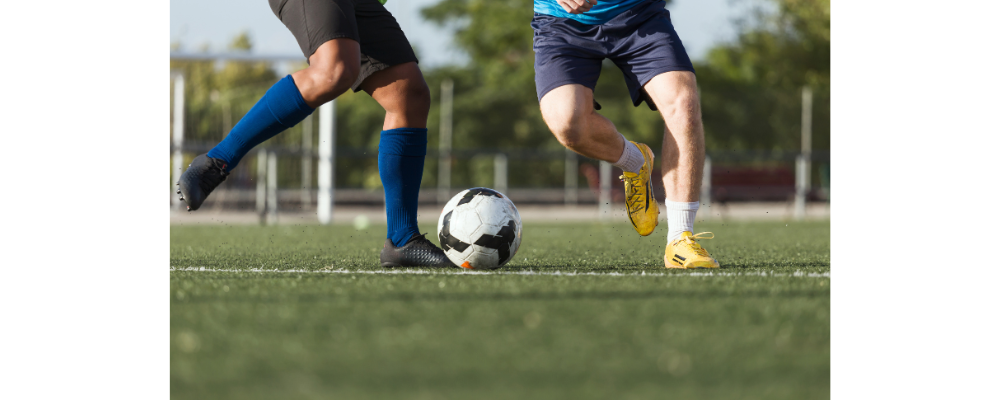
Football involves an unpredictable mix of sprinting, sharp cuts, jumping, and physical contact — all of which place enormous stress on the knee joint. Football knee injuries account for a large proportion of ACL tears seen in sports medicine clinics across Bangalore. Key risk factors for football players include:- Sudden stops and directional changes during play
- Landing awkwardly after headers or aerial challenges
- Direct contact tackles from opponents
- Fatigue-related biomechanical breakdown in late-game situations
- Playing on uneven or hard pitch surfaces
Anatomy of the ACL
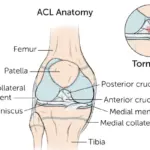
The ACL runs diagonally through the centre of the knee, forming an X-shape with the posterior cruciate ligament (PCL). It is approximately 3–4 cm long and about 1 cm wide, composed of two bundles of collagen fibres: the anteromedial bundle and the posterolateral bundle. Together, these bundles provide rotational stability and prevent excessive anterior translation of the tibia relative to the femur. When the ACL is torn, the knee loses its mechanical anchor, causing instability that makes high-impact sports virtually impossible without treatment.Common Causes of ACL Injuries in Football
The majority of football ACL injuries — approximately 70% — are non-contact in nature. Typical mechanisms include:- Planting and cutting: Quickly changing direction while the foot is planted on the ground
- Hyperextension: The knee being forced beyond its normal range of extension
- Pivoting under load: Rotating the body while the knee bears weight
- Landing with a straight knee: Poor landing technique after jumps
- Direct collision: A tackle that forces the knee inward (valgus stress)
Signs and Symptoms of an ACL Tear
Recognising the symptoms of an ACL injury early is essential for timely treatment. Common signs include:- A loud pop or snapping sound at the moment of injury
- Severe pain and inability to continue playing
- Rapid swelling of the knee within a few hours
- A feeling of the knee giving way or being unstable
- Loss of full range of motion
- Tenderness along the joint line
When Should You See an Orthopedic Surgeon?
Do not wait and see if the pain improves on its own. You should consult a sports orthopedic surgeon if:- Your knee swells significantly within hours of the injury
- You heard a popping sound at the time of injury
- You cannot put weight on the affected leg
- Your knee feels loose or unstable when walking
- You have experienced repeated episodes of the knee giving way
How Is an ACL Injury Diagnosed?
MRI and Clinical Evaluation
Dr. Vijaykumar D uses a combination of clinical tests and imaging studies to confirm an ACL diagnosis:- Lachman Test: Assesses anterior tibial translation — the most sensitive physical test for ACL tears
- Anterior Drawer Test: Checks forward movement of the tibia relative to the femur
- Pivot Shift Test: Evaluates rotational instability of the knee
- MRI Scan: Provides definitive imaging of ACL integrity, associated meniscal tears, bone bruising, and cartilage damage — an MRI for ACL injury is accurate in over 95% of cases
- X-ray: Rules out associated fractures around the knee
Why Early Treatment Matters
Delaying treatment for an ACL tear has consequences that extend well beyond a longer recovery. When the ACL is torn and the knee is unstable, every subsequent step or movement risks further damage to the meniscus and articular cartilage. This secondary damage can cause chronic pain, accelerated joint degeneration, and early-onset arthritis. Football players who return to sport without treating their ACL tear face a significantly elevated risk of meniscal tears, cartilage lesions, and complete joint failure. Early and appropriate ACL treatment — whether surgical or conservative — protects the long-term health of the knee.Non-Surgical Treatment Options
Not every ACL injury requires surgery. For patients with partial tears (Grade I or II), low physical activity demands, or significant comorbidities, conservative management may be appropriate. This includes:- RICE Protocol: Rest, Ice, Compression, Elevation — for acute pain and swelling management
- Physiotherapy: Strengthening of the quadriceps, hamstrings, and hip stabilisers to compensate for ACL instability
- Bracing: Use of functional knee braces to provide external stability during daily activities
- Activity Modification: Avoiding high-risk movements and sports that provoke instability
What Is Arthroscopic ACL Surgery?
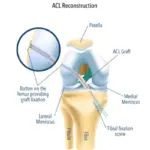
Arthroscopic ACL surgery — also known as ACL reconstruction — is a minimally invasive surgical procedure that replaces the torn ligament with a graft tissue to restore knee stability and function. It is performed through small incisions using a tiny camera called an arthroscope. The procedure is highly precise, leaves minimal scarring, and allows for a faster recovery compared to open surgery. Dr. Vijaykumar D specialises in arthroscopic ACL surgery and follows internationally accepted surgical protocols to achieve optimal outcomes for his patients in Bangalore.Step-by-Step ACL Reconstruction Procedure
- Anaesthesia: The patient receives general or spinal anaesthesia
- Portal creation: Two or three small incisions (portals) are made around the knee
- Arthroscope insertion: A thin camera is inserted to provide a high-definition view of the joint
- Graft harvesting: The chosen graft is carefully harvested from the patient (autograft) or a donor source (allograft)
- Tunnel drilling: Precisely placed bone tunnels in the femur and tibia guide the graft into the correct anatomical position
- Graft fixation: The graft is secured in the tunnels using bioabsorbable screws or cortical buttons
- Closure and dressing: The portals are closed with sutures and a compression bandage is applied
Graft Options for ACL Surgery
The choice of graft is a critical decision in ACL reconstruction. Dr. Vijaykumar D discusses graft options with each patient based on their age, activity level, and specific requirements:- Patellar Tendon Autograft (Bone-Patellar Tendon-Bone): Considered the gold standard for high-demand athletes; provides excellent strength and reliable fixation
- Hamstring Tendon Autograft (Gracilis/Semitendinosus): Most commonly used; lower donor site morbidity and faster harvest
- Quadriceps Tendon Autograft: Gaining popularity in revision cases and larger patients; provides a robust graft
- Allograft (Donor Tissue): Used in revision surgeries or older, less active patients; eliminates donor site pain but has a slightly higher reinjury rate in young athletes
Recovery Timeline After ACL Surgery
Recovery from arthroscopic ACL surgery is progressive and follows a structured rehabilitation protocol. General timelines include:- Week 1–2: Pain and swelling management, walking with crutches, initial range of motion exercises
- Week 3–6: Weaning off crutches, progressive quadriceps strengthening, cycling on a stationary bike
- Month 2–3: Closed-chain strengthening, balance and proprioception training, light jogging on flat surfaces
- Month 4–6: Sport-specific drills, agility training, running on varied terrain
- Month 6–9: Return-to-sport testing, functional strength assessment, clearance for competitive play
Physiotherapy and Rehabilitation
Physiotherapy is as important as the surgery itself. A structured ACL rehabilitation programme managed by a specialist physiotherapist includes:- Early mobilisation and swelling reduction
- Progressive strengthening of the quadriceps, hamstrings, and calf muscles
- Neuromuscular retraining and proprioception exercises
- Plyometric and jump-landing training
- Sport-specific movement patterns and agility drills
- Psychological readiness assessment before return to competition
When Can Athletes Return to Football?
Return to football after ACL surgery is not determined by time alone. Objective criteria must be met before a player is cleared for competitive play. These include:- Quadriceps strength symmetry of at least 90% compared to the uninjured leg
- Successful completion of sport-specific agility tests
- Full, pain-free range of motion
- Psychological readiness and confidence to compete
- Clearance from the treating surgeon after clinical assessment
Success Rates of Arthroscopic ACL Surgery
Arthroscopic ACL reconstruction is one of the most successful procedures in sports orthopedics. Published data indicates:- Overall success rate of 80%–90% for return to pre-injury sport level
- Graft failure rate of 5%–10% within five years (lower with experienced surgeons and proper rehabilitation)
- Patient satisfaction rates consistently above 85%
- Significantly lower rates of re-rupture compared to conservative treatment in active athletes
Risks of Delaying ACL Treatment
Postponing evaluation and treatment of an ACL injury carries real consequences:- Progressive meniscal damage — each episode of instability risks tearing the meniscus
- Articular cartilage erosion leading to early arthritis
- Chronic knee instability making sports and daily activities difficult
- Increased complexity and poorer outcomes if surgery is eventually performed on a long-neglected knee
- Psychological impact and loss of confidence in the knee’s reliability
Common Myths About ACL Injuries
- Myth: Rest alone will heal a torn ACL. Fact: Complete ACL tears do not heal on their own and typically require reconstruction in active individuals.
- Myth: Surgery is always immediate. Fact: Surgery is usually planned within 3–6 weeks of injury, allowing swelling to subside and the knee to regain motion first.
- Myth: Young athletes recover faster automatically. Fact: Recovery depends on adherence to rehabilitation, not age alone.
- Myth: Bracing replaces surgery. Fact: Bracing provides external support but cannot restore the mechanical function of a ruptured ligament.
- Myth: ACL surgery means the end of a football career. Fact: The vast majority of athletes successfully return to competitive sport with proper surgical and rehabilitation care.
Tips to Prevent ACL Injuries in Football
- Incorporate neuromuscular warm-up programmes such as FIFA 11+ into pre-match routines
- Strengthen the quadriceps, hamstrings, and hip abductors consistently throughout the season
- Practise correct landing mechanics after jumps
- Wear well-fitted football boots appropriate for pitch conditions
- Avoid playing through fatigue when muscle control deteriorates
- Work with a sports physiotherapist on knee stability and proprioception training
Why Choose Dr. Vijaykumar D for ACL Injury Treatment in Bangalore?
When it comes to ACL injury in Bangalore, choosing an experienced orthopedic sports surgeon is the most important decision a patient can make. Dr. Vijaykumar D brings together advanced surgical expertise, a thorough understanding of sports biomechanics, and a patient-centred approach to every case.- Specialist training in arthroscopic knee surgery and ACL reconstruction
- Extensive experience managing football injuries and sports-related knee conditions
- Personalised surgical planning with individualized graft selection
- Access to advanced arthroscopic equipment and modern operating facilities in Bangalore
- Close collaboration with sports physiotherapy teams for structured post-operative rehabilitation
- Evidence-based return-to-sport protocols designed specifically for competitive athletes
- Transparent communication and clear guidance at every stage of recovery
Table 1: ACL Treatment Options Comparison
| Treatment Method | Recommended Patient | Procedure | Recovery Time | Success Rate |
| RICE & Rest | Grade I sprains, elderly/low-activity patients | Ice, compression, elevation, activity restriction | 4–8 weeks | Moderate for low-demand patients |
| Physiotherapy (Conservative) | Partial tears, low-activity adults | Strengthening, bracing, proprioception training | 3–6 months | Limited for return to sport |
| Arthroscopic ACL Reconstruction (Autograft) | Active athletes, complete tears, football players | Minimally invasive graft replacement under arthroscope | 9–12 months | 80%–90% return to sport |
| Arthroscopic ACL Reconstruction (Allograft) | Revision surgery, older/less active patients | Donor tissue graft used for reconstruction | 9–12 months | 75%–85% (slightly lower in young athletes) |
| PRP Adjunct Therapy | Used alongside surgery to enhance healing | Platelet-rich plasma injected at graft site | Adjunct — does not alter main timeline | Supportive evidence, not standalone |
Table 2: Arthroscopic ACL Surgery vs Conservative Treatment
| Factor | Arthroscopic ACL Surgery | Conservative Treatment |
| Suitable Patients | Active athletes, complete ACL tears, football players | Partial tears, sedentary/elderly patients, Grade I–II injuries |
| Procedure | Minimally invasive graft reconstruction under arthroscope | Physiotherapy, bracing, rest, and activity modification |
| Recovery Time | 9–12 months for full sport return | 3–6 months for daily function (sport return often incomplete) |
| Return to Sports | Full competitive sport in 80–90% of patients | Competitive sport rarely achievable with complete tears |
| Success Rate | 80%–90% return to pre-injury sport level | 30%–50% return to competitive sport for complete tears |
| Risk of Reinjury | 5%–10% graft rupture rate with proper rehab | High risk — repeated instability episodes likely in athletes |
Conclusion
An ACL injury in Bangalore does not have to mean the end of your football journey. With the right diagnosis, timely treatment, and expert surgical care, the vast majority of athletes make a full recovery and return to competitive play. Arthroscopic ACL surgery, when performed by an experienced specialist like Dr. Vijaykumar D, offers football players the safest, most effective path back to the pitch. From your first consultation to your final clearance for sport, Dr. Vijaykumar D is committed to guiding you through every step of your ACL recovery journey in Bangalore. The sooner you seek help, the better your outcome will be — do not wait.Frequently Asked Questions:
What are James Heal consumables used for in textile labs?
James Heal consumables are used for testing fabric and garment properties, including colour fastness, abrasion, pilling, washing, rubbing, and chemical resistance in textile and garment laboratories.
Which types of James Heal consumables does Amith Garment Services supply?
We supply abrasion fabrics, pilling fabrics, crocking fabrics, standard reference fabrics, and chemical solutions compatible with James Heal textile testing equipment.
Why should I buy from a James Heal consumables supplier in Bangalore?
Buying locally from a trusted supplier in Bangalore ensures authentic products, timely delivery, and technical support for laboratory operations and quality testing.
Can James Heal consumables be used for garment testing in export-quality labs?
Yes. These consumables are widely accepted for international testing standards and help maintain compliance for garment exports, buyer approvals, and ISO/AATCC-certified laboratories.
How do I order James Heal consumables from Amith Garment Services?
Contact us at +91 984 505 3517 or email [email protected]. Our team will provide product guidance, quotations, and delivery options across Bangalore and India.
Are the consumables compatible with all James Heal testing machines?
Yes. All supplied consumables are fully compatible with James Heal textile testing equipment, ensuring accurate and reproducible test results for fabrics and garments.